How to Choose the Right Software Development Company for Your Startup
A practical, conversion-focused guide for startup founders
iAppstack Editorial & Engineering Team
Digital Product & Startup Strategy Specialists

Turning a startup idea into a reliable digital product takes more than writing code. You need to understand the problem, validate the solution, prioritize features, choose appropriate technology, and build something that can evolve as your business grows. The software development company you choose can influence every one of those decisions.
For startup founders, the decision can feel difficult. One provider may offer a low quote, another may promise a fast launch, and a third may present an impressive portfolio. But a polished proposal does not automatically mean a team understands your market, communicates clearly, or will help you make sound product decisions. The right partner should do more than deliver the first version. They should help you reduce avoidable risks, make informed trade-offs, and establish a practical foundation for future improvements. This guide explains how to define your needs, evaluate potential development companies, compare proposals, identify warning signs, and choose a partner that fits your startup’s goals.
Start With the Business Problem, Not the Feature List
Before contacting development companies, write down the problem your startup intends to solve and who experiences it. A feature list is useful, but it should follow from a clear understanding of the user, business model, and outcome you want to achieve. Prepare a short product brief that answers these questions:
Essential Product Brief Questions
- Who is the target user, and what problem are they trying to solve?
- What do users do today, and where does the current process fall short?
- What is the core value proposition of the product?
- What is the first measurable outcome you want to test?
- Which features are essential for launch, and which can wait?
- What constraints matter most: budget, launch timing, integrations, compliance, or internal resources?
For example, a startup planning a booking platform may initially list customer profiles, calendars, payments, notifications, ratings, chat, analytics, and an administrator dashboard. But its first release may only need booking, confirmation, payment, and basic administration to test whether customers will use the service.
A good development partner will challenge assumptions constructively and separate launch-critical requirements from later enhancements. You do not need a perfect specification before speaking to a vendor. You do need enough clarity to explain the problem, users, intended outcome, and major unknowns. A capable partner can help turn that starting point into a structured scope.
Decide What Kind of Partner You Need
“Software development company” can describe businesses with very different strengths. Some focus on mobile apps, others specialize in SaaS products, enterprise systems, websites, or dedicated engineering teams. Choose a partner based on the work you actually need—not simply the broadest service list.
Product Discovery & Validation
Useful when the idea is still evolving and you need help defining user journeys, validating assumptions, prioritizing features, and shaping a minimum viable product (MVP).
UI/UX Design
Important when you need user research, information architecture, wireframes, prototypes, usability testing, or a consistent design system before development.
Mobile App Development
Relevant when users need a mobile experience, device capabilities, push notifications, or access through Android and iOS. Ask whether cross-platform or native development fits the product.
Website & Web Application Development
A fit for marketing websites, customer portals, booking systems, dashboards, marketplaces, and browser-based workflows. Clarify whether you need a content-managed site or custom application.
SaaS Platform Development
Relevant for products serving multiple customers or organizations, especially when accounts, permissions, subscriptions, administration, reporting, and ongoing releases are involved.
Maintenance & Ongoing Development
Important after launch, when you need bug fixes, compatibility updates, monitoring, new features, performance improvements, and a clear process for prioritizing work.
Some startups need several of these capabilities from one partner; others benefit from a specialist. Ask how the company coordinates design, development, testing, deployment, and support. A joined-up process can reduce handoff gaps—but only when responsibilities and decision-making are clear.
Look for Relevant Experience, Not Just a Large Portfolio
A portfolio can show design quality and technical range, but the number of projects alone tells you little about how a company will handle your product. Review work that resembles your product in complexity, audience, platform, integrations, or business model. When reviewing a case study or portfolio item, look for:
- The business problem and intended users—not just screenshots.
- The company’s specific contribution: strategy, design, development, testing, or ongoing support.
- The scope delivered and the platforms or technologies involved.
- Relevant complexities such as integrations, role-based access, data migration, or multi-sided workflows.
- Evidence of how the team handled constraints, changes, or trade-offs.
- A clear distinction between what was delivered and what is planned or claimed as a future result.
If the provider has not built a product in your exact industry, that does not automatically disqualify them. Transferable experience can matter more: building secure account systems, payment flows, dashboards, inventory workflows, or scalable APIs may be directly relevant. Ask the team to explain how previous work relates to your use case.
During a discovery call, ask the team to walk through one comparable project. Listen for specific decisions and lessons, not only broad statements such as “we build scalable apps.”

Evaluate the Team and Its Technical Approach
You do not need to be a technical founder to assess whether a team explains its decisions clearly. Your goal is not to select a framework by yourself; it is to understand whether the proposed approach fits your product, team, budget, and expected growth.
Ask how they choose technologies
A reliable partner should explain the benefits and trade-offs of its proposed stack in plain language. Consider maintainability, performance, integrations, security, hosting, hiring availability, and the team’s ability to support the product over time. Be cautious of answers based only on hype or claims that one technology is always best.
Understand who will do the work
Ask who will lead product discussions, design, architecture, development, quality assurance, and deployment. Clarify whether the people you meet during sales discussions will remain involved after kickoff. If subcontractors or external specialists are used, ask how they are managed and who is accountable.
Check engineering practices
- Version control and code review practices.
- Separate development, testing, and production environments where appropriate.
- Automated tests and manual quality assurance suited to the product’s risk.
- Secure handling of credentials, secrets, personal data, and third-party integrations.
- Documentation for setup, deployment, key decisions, and ongoing maintenance.
- A release process that makes it possible to identify issues and roll back safely when needed.
The right level of engineering discipline depends on the product. A small MVP does not need every process used by a large enterprise system, but it should not be built in a way that makes basic maintenance, testing, or ownership unnecessarily difficult.
Make Sure the Company Understands MVP Thinking
For many startups, the first release should test important assumptions with the smallest practical set of features. An MVP is not simply a low-quality or incomplete product. It is a deliberate first version designed to help the business learn before investing heavily in features users may not need.
Ask prospective partners how they would prioritize your feature list. A thoughtful team will discuss the user journey, core value proposition, dependencies, risks, and what evidence you need from the first release. It should identify features that can be deferred without compromising the product’s essential purpose:
- The target user and main problem being addressed.
- The essential end-to-end user journey.
- The launch features and explicit exclusions.
- The assumptions the release is intended to test.
- Acceptance criteria for key workflows.
- How feedback and usage data will inform the next release.
Be wary of a provider that accepts every requested feature without discussing trade-offs. Scope discipline is about making informed choices so that the first release has a clear purpose and realistic delivery plan.
Assess Communication, Collaboration, and Project Management
Software projects involve decisions, feedback, dependencies, and changes. Communication is part of delivery quality, not an administrative extra. A technically capable team can still be a poor fit if you cannot understand updates, reach decision-makers, or resolve questions promptly. Before signing, establish:
- Who is your primary point of contact?
- How often will progress be demonstrated?
- Which tools will be used for tasks, documentation, and communication?
- How are decisions recorded and approvals obtained?
- How are blockers, risks, and delays communicated?
- Who can approve changes to scope, cost, or timing?
- What input and turnaround time are expected from your team?
Look for a practical rhythm: kickoff and planning, progress updates, regular demonstrations, documented decisions, and clear next steps. The precise cadence can vary, but you should not have to guess what is being built, what is blocked, or what decision is needed from you.

Compare Proposals Beyond the Headline Price
A lower quote is not necessarily better value, and a higher quote is not proof of better quality. Proposals may cover different assumptions, deliverables, testing levels, project management, or post-launch support. Compare them on a like-for-like basis.
What a useful proposal should include
- Understanding of the business problem and project objectives.
- Proposed scope, deliverables, assumptions, and exclusions.
- Phases, milestones, dependencies, roles, and responsibilities.
- Technology approach and important integration considerations.
- Testing, acceptance, deployment, and handover activities.
- Pricing model, payment milestones, and how additional work is handled.
- Support, defect-correction terms, and maintenance options.
- Key risks and decisions that could affect the plan.
Questions to ask about cost
What is included in the estimate, and what is excluded? What assumptions could cause the estimate to change? How will work outside the agreed scope be priced and approved? Are third-party services, hosting, app store accounts, or licences additional costs? What will support and maintenance look like after launch? What happens if priorities change during discovery or development?
If a project is poorly defined, a fixed price may depend on assumptions that later prove incorrect. A time-boxed discovery phase or a clearly scoped first phase can help both sides understand requirements before committing to a larger build. The best commercial model depends on uncertainty, scope, and how decisions will be made.
Check Ownership, Security, and Legal Terms
A startup’s code, designs, data, credentials, and documentation are important business assets. Do not leave ownership and access questions until the project is nearly finished. The agreement should describe who owns what, when ownership transfers, and what happens if the relationship ends.
- Intellectual property: ownership or licensing of custom code, designs, documentation, and deliverables.
- Third-party components: open-source libraries, commercial licences, and usage restrictions.
- Repository access: who controls the source-code repository and how access is managed.
- Accounts and infrastructure: ownership of cloud hosting, domains, app store accounts, analytics, and related services.
- Data protection: what data is collected, where it is processed, who can access it, and how it is protected.
- Confidentiality: how business plans, user information, credentials, and proprietary material are handled.
- Exit and handover: documentation, source files, access, and transition assistance if the engagement ends.
Security should be considered from the beginning. Ask how the team handles access control, dependency updates, secrets, backups, vulnerability fixes, and sensitive data. The controls should match your product’s data and risk profile. For regulated or high-risk products, seek appropriate legal and security advice.
Understand Testing, Launch, and Post-Launch Support
Launching the first version is an important milestone, but it is not the end of the product lifecycle. Real users, devices, integrations, and usage patterns can reveal problems that were not obvious during development. Ask how the team plans to test, release, and respond when issues appear.
- Which user journeys and edge cases will be tested?
- How will bugs be documented, prioritized, and resolved?
- Who approves a release, and what defines acceptance?
- How will the production environment be configured and secured?
- What monitoring, backups, and recovery arrangements are appropriate?
- Will the team help with app store submissions or deployment, if required?
- What documentation and training will be provided at handover?
Clarify what post-launch work is included and for how long. Distinguish defect correction from new feature development, third-party service costs, infrastructure management, and ongoing maintenance. Agree how urgent issues are reported, how work is prioritized, and whether support requires a separate plan.
Plan how you will learn from the release. Depending on the product, this might include analytics, user interviews, support requests, conversion measures, or operational data. Use evidence to decide what to improve next rather than treating launch as the finish line.
Watch for These Red Flags
Guaranteed outcomes before understanding the scope
Promises of success, exact dates, or fixed outcomes before requirements and dependencies are understood may indicate that risks are being overlooked.
Vague proposals
If the proposal does not explain deliverables, exclusions, acceptance criteria, or responsibilities, it will be difficult to compare offers or manage expectations.
Little curiosity about your users
A team that jumps straight into coding without discussing users, goals, and priorities may build features that do not solve the right problem.
Unclear ownership and access
Be cautious if you cannot establish who will own the repository, accounts, source files, designs, or other deliverables.
No credible testing or release plan
Treating testing as an optional final step can leave important defects and operational risks undiscovered.
Poor communication during sales
Repeatedly missed meetings, unclear answers, or unexplained delays before the project begins may indicate future collaboration issues.
Pressure to commit immediately
A trustworthy partner should allow reasonable time to review the scope, terms, references, and risks.
Unusually low pricing without an explanation
Ask whether important work is excluded, effort is underestimated, or additional charges may appear later.
Questions to Ask Before You Sign
Use these questions in vendor meetings. You do not need to ask every question in the first call; select the ones that reveal the most important risks for your product:
- 1What do you understand to be the core problem this product should solve?
- 2What would you recommend for the first release, and what would you defer?
- 3Which assumptions need validation before a reliable estimate can be made?
- 4Who will work on the project, and who will be accountable for delivery?
- 5Can you explain a relevant project and the key lessons from it?
- 6How will you communicate progress, blockers, and decisions?
- 7How do you manage scope changes and estimate additional work?
- 8How will you test the main workflows and define acceptance?
- 9Who will own the source code, designs, accounts, and documentation?
- 10What support is available after launch, and what does it include?
- 11What do you need from us to keep the project moving?
- 12What are the biggest risks you see in our current plan?
Use a Scorecard to Compare Development Companies
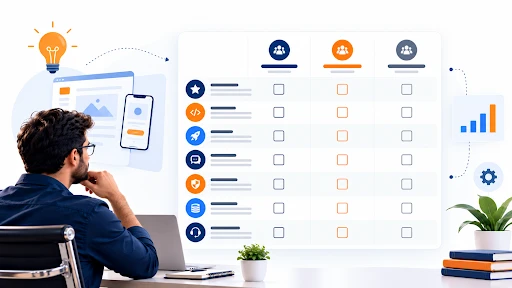
Use a simple scorecard to make the decision more objective. Rate each provider from 1 (weak) to 5 (strong). Adjust the weights to reflect your priorities. A score should support—not replace—your judgment, reference checks, contract review, and direct conversations.
| Evaluation criterion | Suggested weight | What good looks like |
|---|---|---|
| Relevant experience and problem understanding | 20% | Can explain related work, user flows, architecture trade-offs, and your product's key challenges. |
| Technical approach and maintainability | 15% | Technology choices fit the product, budget constraints, security requirements, and expected evolution. |
| MVP prioritization and product thinking | 15% | Can separate launch essentials from deferred features; challenges assumptions constructively to protect budget. |
| Communication and project management | 15% | Clear single point of contact, frequent demos, documented decisions, transparent blockers, and defined escalation. |
| Quality, security, and release practices | 15% | Automated/manual QA suited to risk, secure secret handling, staging/production parity, and safe rollback plans. |
| Scope and commercial transparency | 10% | Clear assumptions, written exclusions, transparent pricing structure, and a documented change approval process. |
| Ownership and post-launch support | 10% | 100% IP rights transfer, immediate repository access, accounts in client's name, and defined defect warranty/support. |
Optional scoring: rate each criterion from 1–5, multiply by its weight, and compare totals. Record concerns and follow-up questions too, so a high score does not hide a critical risk.
Follow a Step-by-Step Selection Process
Define the outcome
Write a short brief describing users, the problem, business goals, constraints, and what a successful first release should prove.
Shortlist suitable partners
Look for relevant capabilities, credible project examples, and a delivery approach suited to your stage.
Hold discovery conversations
Ask each team how it understands the problem, what it would validate, and which questions must be answered before estimating.
Compare proposals consistently
Use the same scope assumptions and evaluation scorecard. Separate required features from optional enhancements.
Check references and working style
Where available, speak with previous clients about communication, problem-solving, transparency, and post-launch support.
Review the agreement
Confirm scope, payment terms, change control, IP, confidentiality, security responsibilities, acceptance, termination, and handover. Seek legal advice where appropriate.
Start with a clear kickoff
Agree on responsibilities, communication cadence, decision-makers, first milestones, and how progress will be demonstrated.
Choose a Partner for the Long Term
The best development relationship is built on shared understanding, clear accountability, and the ability to make decisions together. Your startup may change direction as you learn from users, enter new markets, or refine your business model. A good partner should explain the implications of those changes, help you prioritize, and maintain a sustainable product rather than simply accept every request.
Look for a company that is transparent about uncertainty, comfortable asking questions, and willing to explain trade-offs. You should understand what is being built, why it matters, how progress will be measured, and what responsibilities remain with your own team. That clarity is often more valuable than an impressive pitch deck.
How iAppstack Can Help Turn Your Startup Idea Into a Digital Product
Choosing a development partner is about finding a team that understands your goals and can help you move from an idea to a practical, maintainable product. iAppstack offers digital product services spanning mobile app development, website development, SaaS platform development, UI/UX design, graphic design, and digital marketing.
Depending on your requirements, the work may begin with clarifying the product scope and user experience, followed by design, development, testing, and preparation for launch. The right starting point depends on what you already know, what you have built, and which questions still need answers. If you are planning a mobile application, custom website, or SaaS platform, share your idea, intended users, essential features, preferred launch window, and known constraints. This gives the team a useful starting point for understanding the opportunity and discussing possible next steps.
Ready to Discuss Your Startup Project?
Tell us what you want to build, who it is for, and what you need to achieve.
Conclusion
Choosing the right software development company is not about finding the biggest portfolio or the lowest quote. It is about finding a team that understands your business problem, helps you prioritize, explains technical and commercial trade-offs, communicates reliably, and treats quality, security, ownership, and future maintenance as part of the product. Define your goals, ask consistent questions, compare proposals carefully, and confirm the agreement before development begins. A thoughtful selection process can reduce uncertainty and give your startup a stronger foundation for building, launching, and improving its digital product.
FREQUENTLY ASKED QUESTIONS.
READY TO TURN YOUR IDEA INTO A DIGITAL PRODUCT?
Whether you're planning a mobile application, SaaS platform, or custom website, contact iAppstack to explore a suitable development approach.